 Galxe
Galxe quests fit your goals when their requirements match your time and spending limits
Galxe is useful when a quest rewards an activity you want to complete within your available time and budget. Start with eligibility, required actions, and the reward conditions. A short task list can still involve delayed verification, a paid claim, or a raffle rather than a definite payout.
Contents
A quest fits your schedule when its prerequisites, verification delays, and reward conditions leave enough time to finish and claim.
Learning tasks fit a limited session when participation adds value
If your goal is to understand a project, educational tasks can give that session a defined purpose. Quests can include reading material, quizzes, and surveys, alongside social or blockchain activities. The fit comes from the required work: reading and answering questions serves a different goal from making a transaction merely to qualify.
Read the complete task requirements before treating an educational quest as a brief activity. A campaign can combine learning with other prerequisites. Public learning material is the simpler option when you only want the information and have no use for the offered reward. Participation makes more sense when recording the achievement or earning the stated benefit also matters to you.
Existing eligibility keeps preparation within your time budget
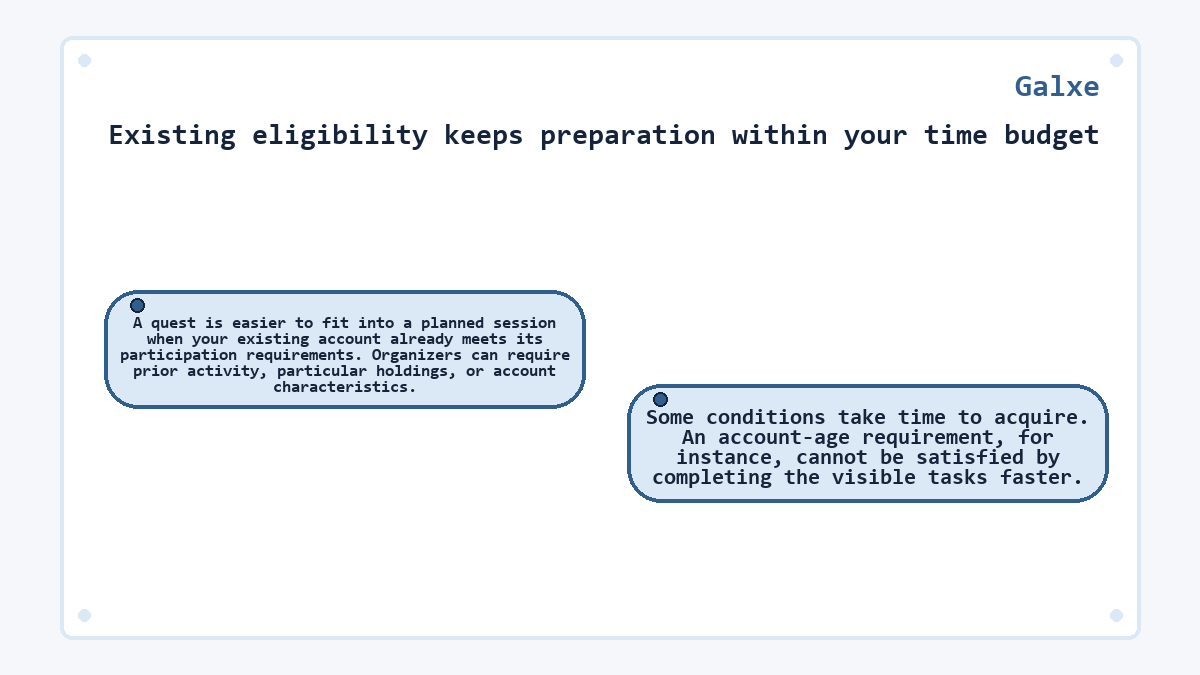
A quest is easier to fit into a planned session when your existing account already meets its participation requirements. Organizers can require prior activity, particular holdings, or account characteristics. Some conditions take time to acquire. An account-age requirement, for instance, cannot be satisfied by completing the visible tasks faster.
Compatibility also includes the reward destination. Social access supports off-chain participation, while EVM rewards require a bound EVM wallet address. EVM refers to the Ethereum Virtual Machine. Check the required address type and reward network before counting a quest as accessible. Binding a primary EVM address is permanent, so account setup deserves its own decision before participation begins.
Skip a quest whose prerequisites require an account commitment or asset purchase that you would otherwise avoid. A smaller task list does not remove that preparation.
The reward must match the outcome you actually want
When your goal is a definite benefit, first establish what successful participation entitles you to receive. Loyalty points, an achievement token, a community role, and a raffle entry have different uses. The displayed reward type should answer your goal without relying on an assumed future conversion or distribution.
Points make sense when the campaign explains a benefit that you value. A collectible can record participation without providing a cash return. Neither a points total nor an NFT establishes entitlement to a later token distribution. Any such entitlement needs explicit campaign conditions, including the qualifying activity and allocation rule.
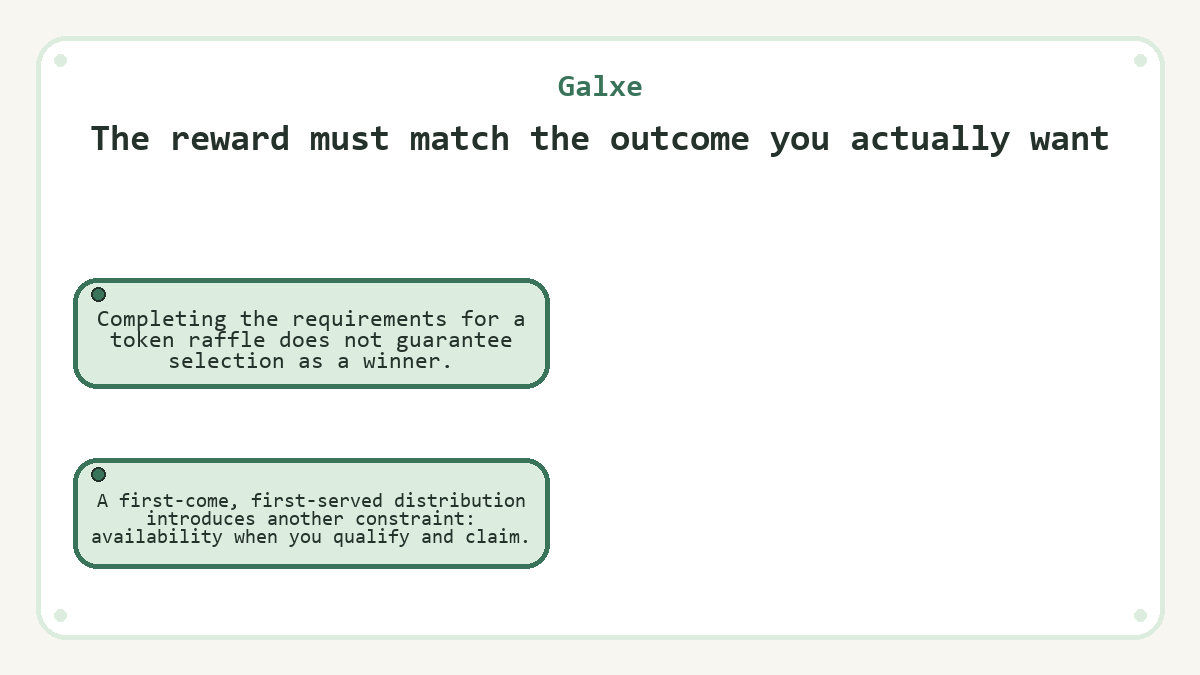
Completing the requirements for a token raffle does not guarantee selection as a winner. A first-come, first-served distribution introduces another constraint: availability when you qualify and claim.
A stated prize pool is the amount available for distribution across the campaign. It is not your personal reward. Raffles suit participation that remains worthwhile without winning; they do not suit a requirement for predictable compensation. Skip the quest when the potential prize is the only reason to perform tasks that would not be worthwhile without winning.
Verification delays and repeat visits determine the calendar fit
A task that requires project approval needs time for review as well as time to prepare the submission. Some quests use manually approved participant records. Completing the requested work and appearing in the eligible record are separate events. A short submission process can therefore leave a longer wait before verification becomes possible.
For a task with a participation deadline, allow for its stated update schedule. A pending review near that deadline is a poor fit when you cannot return later. Treat a campaign's closing time and any subsequent reward-claim deadline as separate appointments. Finishing the work does not remove the need to monitor a raffle result or collect an available reward.
Recurring quests add a different scheduling demand. Their verification and claim states reset on a configured schedule, allowing participation in another cycle. Choose these when repeat visits fit your routine and the loyalty points serve your goal. A one-time quest is the simpler choice when you only have a single session available.
Claim costs belong in the decision before paid activity
A spending limit needs to cover required task activity as well as the eventual reward claim. Network transaction fees and platform claim fees are separate cost inputs. Sponsorship can cover charges in eligible quests, while other campaigns leave costs with the participant. Read the applicable fee conditions instead of treating every quest as free to finish.
Include any required blockchain activity in that assessment. A sponsored reward claim does not, by itself, cover transactions required elsewhere in the task list.
Consider a hypothetical points quest that requires only page visits. Assume the reader already has a compatible account, needs no new account binding, and wants the points only if the cost stays within a $0.74 limit. All amounts in this example are hypothetical: the estimated platform claim fee is $0.19, and the estimated network fee is $0.64.
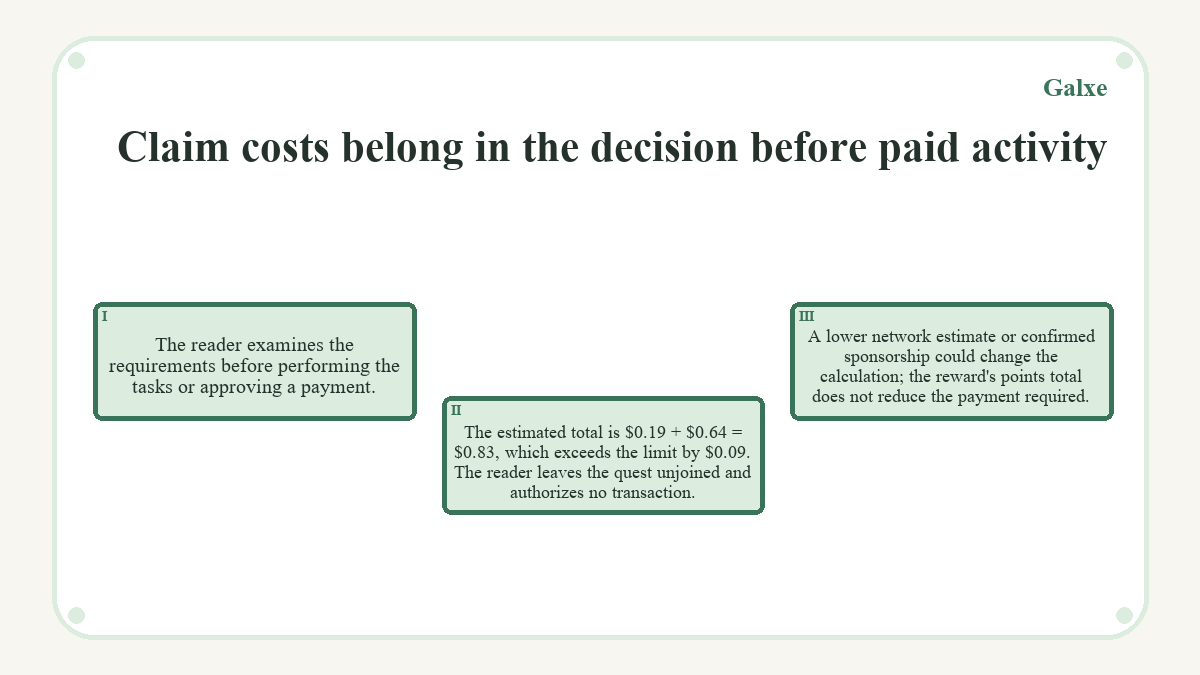
The reader examines the requirements before performing the tasks or approving a payment. The estimated total is $0.19 + $0.64 = $0.83, which exceeds the limit by $0.09. The reader leaves the quest unjoined and authorizes no transaction. A lower network estimate or confirmed sponsorship could change the calculation; the reward's points total does not reduce the payment required.
Completed blockchain transactions cannot simply be undone by abandoning a quest. Any required transaction therefore moves the commitment point earlier than the final reward claim.
Similar task lists can demand different permissions and follow-up
When two quests appear equally manageable, their account permissions and reward conditions can decide which one fits. A social task may require linking an account. A campaign can also request participant information before claiming. Review the information requested and its purpose before authorizing access or submitting it. A modest reward need not justify a connection you do not want.
Compare the observable benefit, too. Access to a particular community role can meet a concrete participation goal. Points require a reason to accumulate them, and a raffle requires willingness to finish without a prize. These differences help select suitable work without turning every available campaign into an obligation.
Even two token raffles can offer different predictability after selection. A Fixed Token Reward Raffle assigns the same token amount to each winner. A Luck-Based Token Reward raffle gives each winner at least $1 worth of tokens and distributes the remaining pool randomly, so winning alone does not establish the exact amount received. Choose the former when a known allocation per winner matters, while remembering that selection itself remains uncertain.
Galxe: common questions
Can recurring Galxe quests award tokens instead of loyalty points?
Recurring quests support loyalty points rather than token rewards. Their scheduled resets allow eligible participants to complete another cycle and claim points again. If your purpose is to receive a token reward, a recurring points quest does not meet that goal merely because it offers repeated participation.
Does an accepted survey submission mean the project has approved my work?
Survey acceptance does not necessarily establish approval of the submitted work. Survey tasks can accept responses automatically. An organizer can review those responses separately and use approved entries for a follow-up eligibility task. Include that additional review when deciding whether a submission-based campaign fits your available time.
Will revisiting a campaign satisfy a prior-participation requirement?
Revisiting a campaign does not substitute for completing the quests counted by a participation requirement. The Space User credential can check completed quests within the organizer's Space. Participation in a quest collection counts once for that measure, rather than once for every quest inside the collection.
Could a gasless raffle still require a payment to receive the prize?
A gasless raffle entry can still leave the winner responsible for the transaction that transfers the prize to their wallet. That transfer cost depends on the reward's blockchain. When deciding whether the raffle fits a spending limit, distinguish sponsored participation from the later cost of receiving a winning allocation.
Is an existing claim-fee discount permanent if I stop participating?
A loyalty-based claim-fee discount on Gravity can decrease when the valid experience points supporting the level expire. Where transition protection applies, the effective fee is the lower of the fees under the previous Claim Fee Tier and the new Loyalty Level. The level uses activity within its applicable validity period and is recalculated daily. For occasional participation, use the discount that applies when claiming rather than assuming an earlier discount remains available.