 Galxe
Galxe connects Web3 identity with quests and campaign rewards
Galxe connects wallet and social identities with community quests that use credentials to assess participation and reward eligibility. A credential records whether an account meets a requirement, such as holding an asset or completing a task. Verified tasks can unlock a claim, enter a raffle, or contribute loyalty points, depending on the campaign's rules.
Participation involves several distinct records: the linked account, each task's verification status, and the reward claim. Their differences matter when an action costs money, a reward remains unavailable, or changing an account could interrupt access.
Wallet access and social login support different activities
An account can begin with a wallet or a social login. Social access supports off-chain participation, while receiving EVM rewards requires a bound EVM address. EVM means Ethereum Virtual Machine, the execution environment that several blockchain networks use.
Supported non-EVM wallets provide another entry path for activities on their respective networks. Their availability does not make them interchangeable with an EVM receiving address. A campaign's task network, reward network, and wallet requirements must each match the intended activity.
Before linking anything, inspect the account that is already signed in. A social connection and a wallet connection can refer to different existing accounts. Keeping the intended identity consistent prevents completed activities from becoming associated with an unexpected profile.
Where does participation become irreversible?
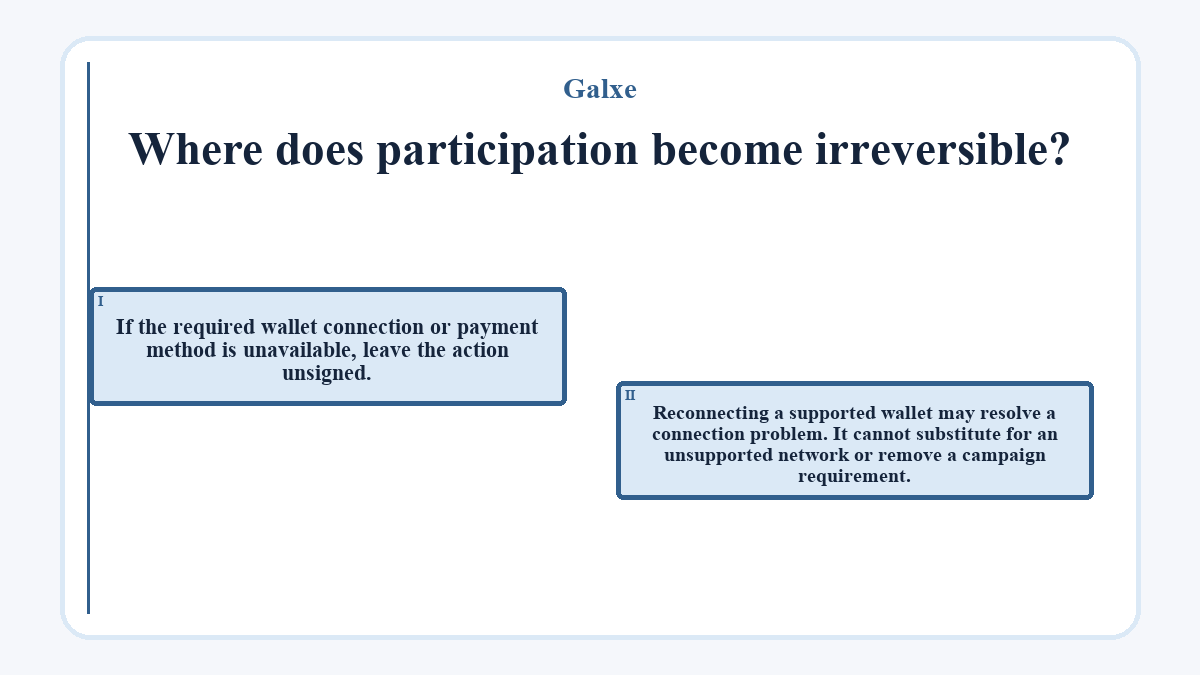
Participation becomes committed at different points, including primary address binding, confirmed blockchain actions, and non-refundable payments. Reading campaign conditions leaves those choices open. A quest's final claim button is not necessarily its first irreversible step.
The primary EVM address bound to a Galxe account cannot be changed or unbound. That address receives Quest EVM rewards. Connecting another wallet does not change the primary address. Earndrop also allows claims using a linked secondary EVM address.
Tasks that involve assets can introduce an earlier commitment. A confirmed transfer or contract interaction has its own consequences, even if the campaign later rejects eligibility. Token approvals also grant permissions that can remain after the task ends.
If the required wallet connection or payment method is unavailable, leave the action unsigned. Reconnecting a supported wallet may resolve a connection problem. It cannot substitute for an unsupported network or remove a campaign requirement.
Credentials connect completed activity with eligibility
Credential verification evaluates the condition that the organizer configured. On-chain tasks can check holdings or contract activity. Other tasks use social integrations, imported participant records, or an application programming interface, usually shortened to API.
The verification method determines what a successful status proves. For X tasks, Authentic Verification checks completed actions, while the page-visit method records intent. A verified badge therefore needs the context of the underlying task.
Manually reviewed submissions follow a different schedule. A project may collect entries, approve qualifying submissions, and update the eligible account list afterward. Submitting an entry does not establish that the reviewer has accepted it. The task's update schedule and participation deadline govern when verification becomes possible.
Keep the original activity record available when a mismatch appears. For a blockchain task, that includes the transaction and the address that performed it. Repeating a paid action before identifying the mismatch can create another expense without satisfying the missing condition.
Campaign parameters determine what progress means
Quest settings establish the conditions that connect participation with a reward. Comparing quests requires reading those settings together: an identical task can lead to a different allocation method or deadline.
| Parameter | Configured value | What it controls | Conditions and timing |
|---|---|---|---|
| Participation requirement | Selected credentials and conditions | Who qualifies | Must satisfy the campaign's applicable requirements |
| Verification source | On-chain query, integration, or imported data | How a task condition is checked | Depends on the source and its update method |
| Token allocation | First-come, first-served or raffle | How eligible participants receive allocations | Availability or winner selection limits receipt |
| Participation end | Organizer's configured deadline | When the task accepts participation | A task deadline can prevent later verification |
| Quest EVM reward destination | Account's primary EVM address | Where Quest EVM rewards arrive | Address binding is permanent |
The campaign's participation period and its reward claim period describe different permissions. Completing an activity during one period does not establish that a claim remains available indefinitely.
Why can verified tasks still leave a reward unavailable?
Verified tasks can leave a reward unavailable when allocation, campaign status, or another participation requirement prevents claiming. First-come, first-served rewards depend on remaining availability. A raffle requires winner selection, so qualification alone does not establish a winning allocation.
Reward types also have different completion states. Loyalty points record participation within a program. NFTs and On-Chain Achievement Tokens, or OATs, represent blockchain-based rewards or achievements. A Discord role can recognize participation or grant permissions within a server. None of these automatically establishes an entitlement to a later token distribution.
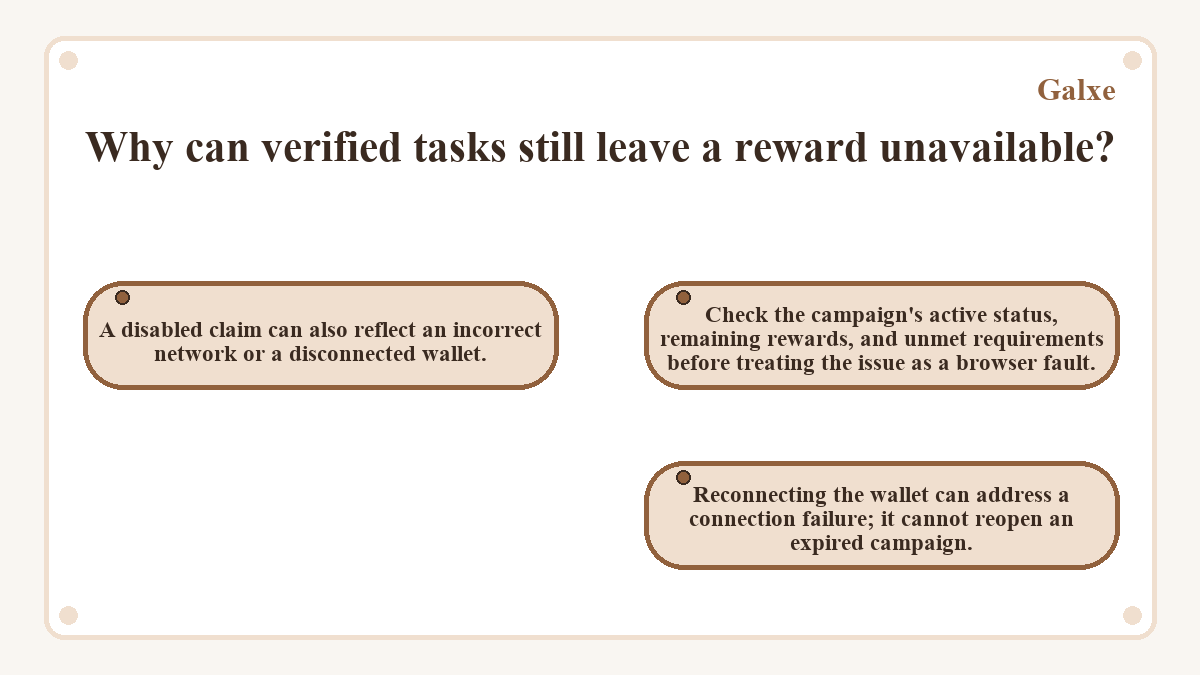
A disabled claim can also reflect an incorrect network or a disconnected wallet. Check the campaign's active status, remaining rewards, and unmet requirements before treating the issue as a browser fault. Reconnecting the wallet can address a connection failure; it cannot reopen an expired campaign.
Claim fees and Smart Balance create separate costs
A quest can involve costs for its underlying activity, its reward claim, and the chosen payment service. Completing a task does not establish the final claim cost. The confirmation details show the payment that the pending action requires.
Some claims incur a claim fee, while sponsorship or applicable membership benefits can cover eligible charges. Discounts have their own conditions. Loyalty Level discounts apply to claims on Gravity, and expiring experience points can affect the level that determines a discount.
Smart Balance provides a shared balance for supported product and network payments. It does not generate yield, and withdrawals are not supported. Issued credits are non-refundable and valid for one year. Depositing therefore commits funds before the eventual quest claim.
Existing Smart Savings funds have separate transition rules: holders can withdraw them before November 1, 2026, or migrate them. Remaining balances will migrate automatically after that date. That withdrawal option applies to legacy Smart Savings funds, not new Smart Balance deposits.
Identity credentials limit what a campaign needs to learn
Galxe Identity Protocol uses zero-knowledge proofs to support selective disclosure of credential information. This lets a verifier assess a required condition without receiving every underlying identity detail. Passport and Score serve different purposes: Passport concerns identity verification, while Score evaluates reputation-related activity. Campaigns choose whether these credentials affect eligibility. Selective disclosure does not make unrelated social posts, submitted survey answers, or blockchain transactions private.
Campaign creation and rewards extend beyond individual tasks
Projects organize campaigns through Spaces and configure tasks, participation requirements, and rewards. Imported records support activities that require project review. Participant exports and campaign analytics help organizers reconcile entries with distribution records. Survey tasks automatically accept submissions. To make eligibility depend on reviewed answers, the organizer can create a follow-up task using an imported list of approved entries.
Earndrop provides token distribution campaigns with configurable conditions. Rewards Hub adds platform engagement features through Galxe Gold and experience points. These programs have their own earning and redemption rules; a campaign's loyalty points do not automatically substitute for their balances.
Choosing when to use a quest begins with the outcome it actually records: participation, access, a credential, or a reward allocation. An organizer seeking reviewed contributions needs a verification method that checks those contributions. A participation count alone does not establish their quality.
What remains after a campaign is finished?
Claim records, received rewards, and any remaining permissions can outlast a campaign. For an on-chain reward, the transaction status and destination account help establish delivery. Off-chain rewards need their own evidence, such as the assigned role or the organizer's fulfillment record.
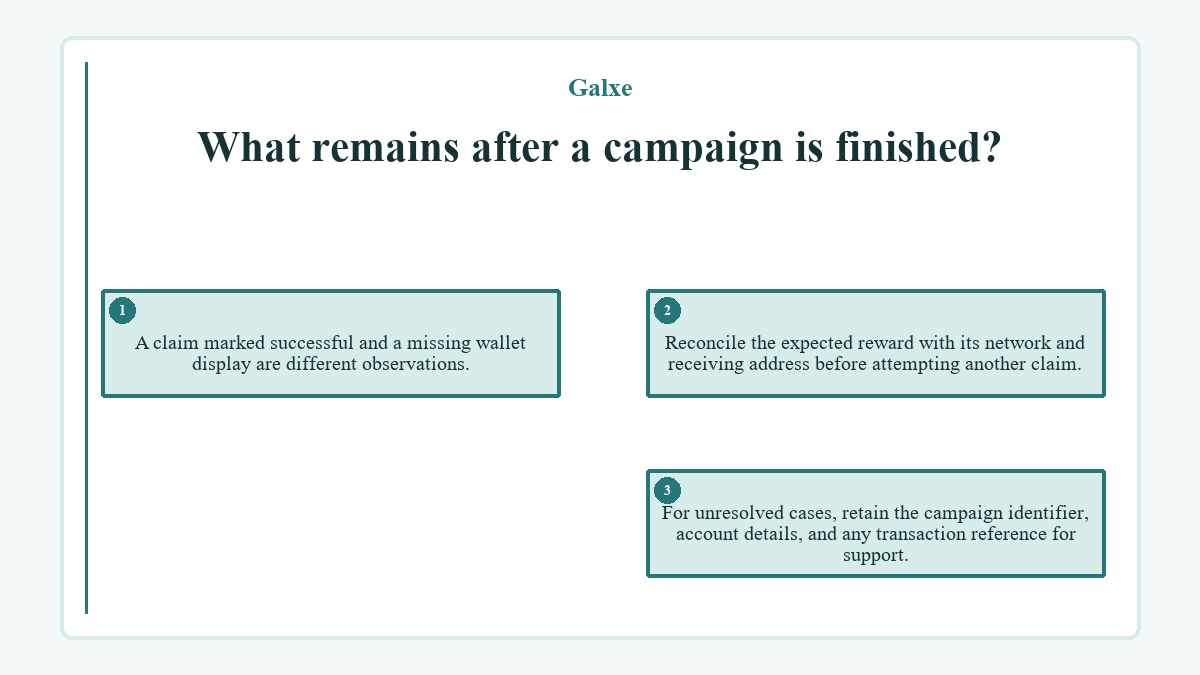
A claim marked successful and a missing wallet display are different observations. Reconcile the expected reward with its network and receiving address before attempting another claim. For unresolved cases, retain the campaign identifier, account details, and any transaction reference for support.
Account settings allow users to remove supported social connections and revoke connected-app permissions. Unlinking a social account can also remove access to rewards tied to it. Token approvals require separate attention when a task granted a contract access to assets. Revoking an approval removes that permission; it does not reverse an earlier transaction or erase the campaign's records.
Galxe questions worth asking
-
Can I change my linked X account during a quest?
- Changing the linked X account during a quest can affect reward eligibility. Verification uses the account associated with participation, and tasks completed through the previous account do not automatically transfer. The old account also stops working as a login once its replacement is linked.
-
Are Galxe Gold and G tokens the same thing?
- Galxe Gold, abbreviated GG, and G tokens have different functions. GG supports Rewards Hub redemption, while G tokens can pay for applicable claims on Gravity. Receiving GG does not mean that the wallet has received an equivalent quantity of G. Rewards Hub earning and redemption conditions determine the available benefits.
-
When does a new activity affect my Galxe Score?
- Galxe Score updates weekly, so a newly completed activity may not appear immediately. Facial verification immediately after minting does not automatically increase the Humanity level. That component changes through the score update process, and completing verification alone does not establish a particular resulting level.
-
Who delivers a campaign's custom reward?
- The project running the campaign delivers custom rewards outside Galxe. The campaign's fulfillment conditions determine what the participant receives and how delivery occurs. A successful participation record does not establish that an external reward has already arrived, so delivery questions belong with the organizer responsible for fulfillment.
-
Why does an Illegal Signature error appear during a claim?
- An Illegal Signature error can result from a device date or time synchronization problem. Correcting the clock settings or trying the claim on another device can help diagnose that cause. The message alone does not establish that the task failed or that the account lost its eligibility.
-
Is a Passport required for every quest?
- A Passport is not a universal requirement for participating in Galxe activities. Individual organizers can require a Passport credential for particular campaigns. A task may also impose a verification-recency condition, so possession of the credential and satisfaction of that task's identity requirements are separate checks.